PHASE 1 - Observe and Listen (Days 1 to 30)
One-on-one interviews · Early Team Bonding · Stakeholder mapping · Cultural immersion · Auditing the existing setup · Setting up your human radar
Objective: understand the existing ecosystem before changing anything. This phase is not passive, it is the most strategic of all.
One-on-one interviews in depth
Meet individually with every member of your team. These are not work meetings they are conversations to understand:
- Their real motivations and what drives their engagement day to day
- The concrete obstacles they face in their work
- Their expectations of you as a manager
- What worked and what failed under previous leadership
- What they would need to be even more effective
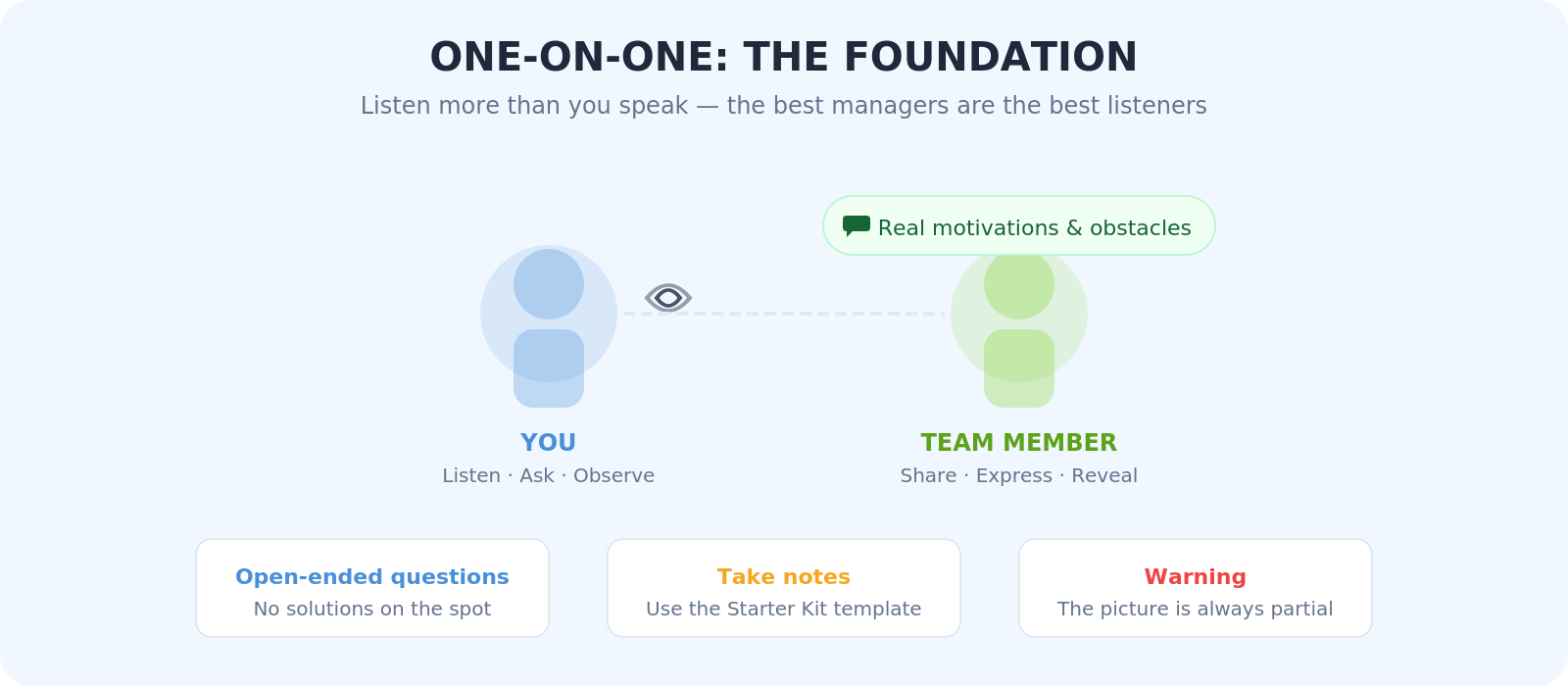
Listen more than you speak. The best managers are the best listeners. Take notes, ask open-ended questions, and resist the urge to offer solutions on the spot.
These conversations give you a picture. But that picture has a limit : people tell you what they think you want to hear. You are new, they do not know you yet, they are being careful. What you gather face to face is valuable, but partial.
To help you structure these early conversations, the starter kit includes a ready-to-use and customisable one-on-one interview template. It lists the questions to ask, in what order, and how to capture the answers so you can use them later.
Use this framework, adapt it to your context, and focus on listening rather than note-taking in real time.
Get the one-on-one templateEarly Team Bonding: Blending Work & Social
Setting up casual gatherings in your first few weeks isn't just about being friendly—it's a strategic tool to build psychological safety and observe real team dynamics outside formal meetings.
1. Practical Event Formats
- Low-Pressure Social Gatherings: Host casual welcome lunches or virtual coffee breaks during work hours to break the ice naturally without encroaching on personal time.
- Hybrid Syncs & Micro-Bonding: Pair brief, informal alignment meetings with casual snacks, or launch a lighthearted async channel (e.g., #watercooler) for lightweight daily connection.
2. What to Observe (The Manager's "Radar")
While social settings should feel relaxed for the team, use these moments as a manager to passively observe:
- Informal Influencers: Who does the team look to for approval when someone makes a joke or raises a topic?
- Psychological Safety: Do people tease each other lightheartedly, or is the mood stiff and guarded?
- Subgroups & Silos: Are certain sub-teams or individuals isolated from the rest of the group?
- Quiet Voices: Who speaks least in group settings? (Plan to give them extra attention during 1-on-1s).
3. Golden Rules for New Managers
💡 Keep it low-pressure: Avoid high-intensity "trust falls" or mandatory after-hours drinks early on. Respect personal boundaries, time zones, and family commitments.
💡 Share before you ask: Be vulnerable first. Share a small mistake you made early in your career or a funny personal anecdote to signal that perfection isn't expected.
Stakeholder mapping
Build a mental map of your environment. Knowing who is who and who influences what is a major strategic advantage:
- Your allies: who can help you navigate the organisation?
- Your peers: who are the other managers and how do they work together?
- Your sponsors: who hired you and who can support you?
- Your internal clients: who depends on your team to move forward?
- Informal power centres: who actually influences decisions?
Cultural immersion
Observe how the organisation truly works not what the org chart says:
- How are decisions really made?
- What are the unwritten rules: what is done, what is not done
- What management style is genuinely valued?
- How are changes communicated and received?
- What gets celebrated? What gets sanctioned?
Auditing the existing setup
Before changing any tools, processes, or rituals, understand why they exist and what they reveal about the team culture:
- Which tools are being used and why were they adopted?
- Are there redundancies or abandoned tools nobody mentions?
- Which processes create friction on a daily basis?
- What team rituals are in place : meetings, communication habits?
Setting up your human radar from day one
One of the most common traps in Phase 1 is relying solely on your own impressions. You leave a one-on-one feeling like everything is fine then three weeks later you find out that person was already looking for another job.
Stress is a team's silent enemy. It accumulates, it spreads, and it is almost always invisible until it explodes in the form of a resignation, a conflict, or a performance collapse.
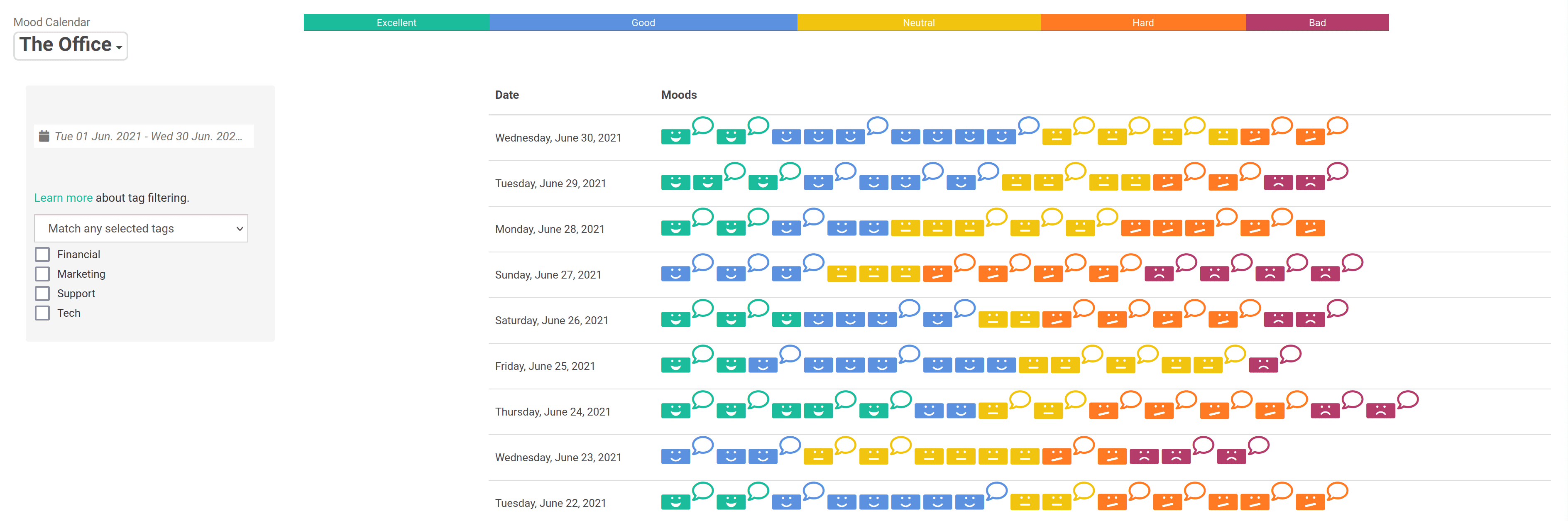
TeamMood was built for exactly this problem. Every day, your team members share their mood with a single click, with the option to add an anonymous comment if they wish but it is never required.
Anonymity is total and guaranteed, which is what allows people to express themselves honestly, without fear of judgement. Day after day, you see a collective mood calendar emerge that works like an internal weather map for your team. From Phase 1, this tool gives you a considerable head start.

